Showing posts with label Schutten Andre. Show all posts

Monday, 26 February 2018

Post 205--Just Check the Box


23 FEB 2018 JUST CHECK THE BOX: THE GROWTH OF STATISM AND WHAT’S NEXT FOR CANADA’S CHRISTIANS

Today I treat you to an article written by Andre Schutten, who wrote this under the banner of ARPA, a Christian political action group--in distinction from a political party--. You've read about and from ARPA before if you're a regular reader of this blog. "ARPA" means "Association for Reformed Political Action."  "Reformed" does not refer to a former Canadian political party by that name, but means "Calvinistic."  It's a group comprising mostly of various smaller Reformed or Calvinistic Canadian churches, but the organization itself does not belong to any church.  It a political action and advisory group that is independent from any church.

Here then Andre Schutten:
Solitary Refinement
Last month I attended a particularly moving live stage production called Solitary Refinement. The play is based on true stories of persecution. It focuses on the suffering of Romanian pastor Richard Wurmbrand, imprisoned and tortured for 14 years – including two years in solitary confinement – for placing his faith in Jesus above his allegiance to the Communist government. (The play is currently on tour, and I encourage you to attend or have it come to your church. There is also a movie of Wurmbrand’s story coming out in March.)
The play moved me to think about three things over the past few weeks: first, the damage and terror inflicted by communism, socialism, and other totalitarian governments; second, how particular episodes in Canadian political drama of the last few months have an eerie similarity to the first experiences of Wurmbrand with communism; and third, how unprepared Western Christians are to face such totalitarianism.
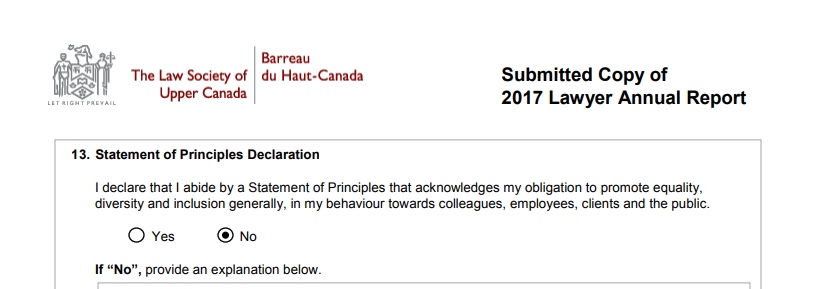
In present-day Canada, two government institutions require citizens to affirm State ideology in order to enjoy the equal benefit of the law or government programs. The first is the Law Society of Ontario. It announced several months ago that all licensed Ontario lawyers are now required to affirm that they will “abide by a Statement of Principles that acknowledges my obligation to promote equality, diversity and inclusion generally, in my behaviour towards colleagues, employees, clients and the public.” All that lawyers have to do is “just check the box”.
Then, right around Christmas, the Hon. Patty Hajdu, Canada’s Minister of Employment, Workforce Development and Labour, announced that citizens applying for a Summer Student Jobs grant had to “just check the box” to affirm that “the job and the organization’s core mandate respect … the values underlying the Canadian Charter of Rights and Freedoms as well as other rights. These include reproductive rights…”  
The State is Progressive. Christianity is Regressive.
Thousands of Canadian Christian charities doing wonderful work in refugee resettlement, summer camps for underprivileged kids, poverty relief, addictions help, and assistance for at-risk youth, must “respect” “reproductive rights” (which include unfettered abortion, according to the government’s explanatory manual) or risk losing out on thousands of dollars. When pushed on this, the Minister said it’s no big deal to “just check the box”, even if you do believe that the pre-born child is a human being worthy of protection in law.
So, what’s the big deal? Is checking a box really the end of the free world? Let’s look at the communist regimes of not so long ago to understand what is at stake.
The State is Progressive. The State is Progressive. Christianity is Regressive. Christianity is Regressive.” Wurmbrand recounts that this refrain reverberated continually between the loudspeaker and the concrete prison walls inside the Communist prisons of Eastern Europe to brainwash prisoners. It was also a mantra dogmatically drilled into all students attending mandatory State-run schools.
Václav Havel was a dissident writer in communist Czechoslovakia. His plays pilloried communism. As Havel became more politically active, he fell under surveillance of the secret police. His writing landed him in prison multiple times, the longest stint lasting almost four years. He later became the president of the Czech Republic (which formed shortly after the fall of the Soviet Union). His most famous essay is The Power of the Powerless – well worth studying as statism increases in the West and the terrors of communism fade from memory.
Rod Dreher, in his book The Benedict Option, describes a central point of Havel’s famous essay:
Consider, says Havel, the greengrocer living under Communism, who puts a sign in his shop window saying, “Workers of the World, Unite!” He does it not because he believes it, necessarily. He simply doesn’t want trouble. And if he doesn’t really believe it, he hides the humiliation of his coercion by telling himself, “What’s wrong with the workers of the world uniting?” Fear allows the official ideology to retain power – and eventually changes the greengrocer’s beliefs. Those who “live within a lie,” says Havel, collaborate with the system and compromise their full humanity.
That is what’s happening with these check boxes today. It’s so simple – by design – to affirm the State ideology of “inclusion” and “reproductive rights”. Just check the box. And yet what’s actually happening is a wearing away or a numbing of our convictions. Like the greengrocer in Communist Czechoslovakia, we fear the trouble of dissenting. We need the funds. We want to keep our license. As Dreher further explains,
Every act that contradicts the official ideology is a denial of the system. What if the greengrocer stops putting the sign up in his window? What if he refuses to go along to get along? “His revolt is an attempt to live within the truth” – and it’s going to cost him plenty. He will lose his job and his position in society. His kids may not be allowed to go to the college they want to, or to any college at all. People will bully him or ostracize him.
[We have] said that the emperor is naked.
But we must dare to dissent. We need to live within the truth. We have a better and deeper and richer understanding of “diversity” and “inclusion”. We know what murderous lies are hidden behind the euphemism of “reproductive rights”. Because we love our neighbours as ourselves, we dare to dissent because we know what is true, good, and beautiful. And it’s worth fighting for.
As Dreher says, channeling Havel, when we do dissent, “by bearing witness to the truth, [we] accomplish something potentially powerful. [We have] said that the emperor is naked. And because the emperor is in fact naked, something extremely dangerous has happened: by [our] action, [we have] addressed the world. [We have] enabled everyone to peer behind the curtain. [We have] shown everyone that it is possible to live within the truth.”
And so, when I filed my annual report at the end of 2017, I declined to check the box. I wrestled for a long time about whether to check the box. I rationalized checking the box. After all, what’s so wrong with a statement on “diversity and inclusion”? But I concluded that what was motivating me to check the box was fear: fear of professional consequences, fear of the hassle, fear of what others might think of me. And while I do fear the State in a Biblical sense, I can’t do what it is asking of me because I’d ultimately be lying. My statement of principles in not what they are actually looking for.
LSUC statement of principles declaration
So I checked no, and then explained myself:
The Law Society of Upper Canada has no clue what the words “equality” “diversity” or “inclusion” mean as demonstrated in its unequal, exclusive and intolerant treatment of Trinity Western University graduates. I hold to an ethic that is deeper and richer and more meaningful than any superficial virtue-signalling that the law society cobbles together. However, the law society has no authority, constitutional or otherwise, to demand it of me. I, therefore, refuse on principle to report such a statement to the law society.
It’s not the most eloquent thing I’ve written. But I dissented.
So where do these check boxes take us? What’s next? I can’t help but think that the check boxes are a trial balloon of sorts. If the current government can get away with enforcing moral conformity as a condition for receiving summer job grants, can it do the same for charitable status? Will the other regulated professions (medicine, accounting, engineering, etc) include check boxes? Will all charities in the next few years have to check the box each year to affirm the “Charter values” of inclusion and non-discrimination and reproductive rights in order to keep their charitable status? And after that, will our Christian schools have to check the box to keep the doors open? Will we as parents have to check the box to access medical care for our kids? What’s next?

Are we prepared for what comes next? I’m not saying this is the way it will go. I am optimistic that when Christians stand up for what is right, good things happen. God blesses faithful witness. So I hope and pray for a revival in Canada and I know it is possible, by God’s grace. But if the trajectory we are on continues downward, are we prepared?

Wednesday, 28 June 2017

Post 174--Disrupting Church Services--Zombie Prohibition?


I am a writer. As such, I do a lot more than just writing this particular blog. I operate an extensive website I've told you about frequently--< www.SocialTheology.com >--as well as another blog--
<  ChristianMuslimWorld >--. Sometimes they overlap such as when I decide a certain article, either my own or a guest article, is suitable for the other vehicle as well. In all of them I occasionally share articles with you about the gradual pushing Christianity out of the way here in Canada, but also in other countries.  In some countries it is another religion that persecutes Christians. This is true especially in Muslim and Communist countries, but also happens in Buddhist and Hindu nations.

It also happens in Western countries, including Canada. However, in the West, it is often under the radar so that most  people do not notice. Hence they often feel that talking about persecution of Christians in Western countries is a matter of paranoia, a distorted imagination. I plan to exposing this dangerous tendency by giving it more coverage to show you it's not just paranoia or imagination. It happens. It's true. But usually it is done in such small steps and in such hidden ways that people either not notice or just shrug their shoulders as a non-issue that is blown all out of proportion.

And true enough, in many cases these are small issues that by themselves are not all that significant. However, when you pay attention and put them all in a row you have to come to the conclusion that there is definitely a tendency, an important tendency in Canada, for example, of slowly putting tiny screws on what on the surface look like minor issues.

And while in two paragraphs back I point to other religions plus Communism as the perpetrators, here in Canada it is mainly the people with secular or liberal agendas who are behind it all.  Note that I refer to"liberal," not to"Liberal" as in the Liberal Party, though that Party has its share of supporters for this movement. But it's not only those with such an agenda, there are also kind people among them whose secular or liberal definition of religion blinds them to its real nature. So, when anti-Christian measures come on the table, they don't even recognize them to be anti-Christian in however minute shape.

Today I treat you to an interview published by Lighthouse News, an online news source operated by ARPA--Association for Reformed Political Action, "Reformed" being another term for "Calvinistic," not the former Reform Party. It is also close to Presbyterianism, but that's for another time. You will profit the most from this interview if you also pursue the links in the document. 


                                 DISRUPTING CHURCH SERVICES

André Schutten, Director of Law and Policy - ARPA Canada
As we told you a few months ago on Lighthouse News, the federal government is making a move to eliminate so-called “zombie laws”. These are essentially old laws       which are no longer in effect. The most common reason for their obsolescence is that they’ve been struck down by the court. While those laws are technically still on the books, they have become unenforceable, so they need to be removed to reflect that reality. But earlier this month, the federal Liberals introduced a second bill to eliminate some other old laws, and one of those eliminations could have an impact on every single pastor, and every single church, mosque, synagogue, or Sikh temple in the country. This is a completely separate bill from the one we discussed back in March. On the feature today, ARPA’s Law and Policy Director, André Schutten, on what the government is doing with this latest bill.
LN: Andre, let’s start with some background on the difference between these two bills.
AS: So they have a zombie law [Bill C-39] already and that one targets all these old Criminal Code provisions that were ruled unconstitutional, right? And so, I’m not really sure what the government’s up to. It might be that they’re trying to pass other stuff through this one and they use that description as cover. So C-39, which is also that – unconstitutional provisions, right – it’s “An Act to amend the Criminal Code (unconstitutional provisions) and to make consequential amendments to other Acts” from the Minister of Justice. So that one is the zombie law one. So I don’t know what else they’re trying to do with C-51, but I imagine that what they’re trying to do is they’ve got this cover going on, and they’re saying “Look! All we’re doing is cleaning up the Code again, and we’re just taking care of anything that’s probably unconstitutional.” But what they’re doing with that is they’re also taking out sections that aren’t unconstitutional; that are actually good sections (but) they just don’t feel like debating them.
LN: And that brings us to the central issue here. Right now, the Criminal Code says you can’t harass or assault a clergyman or minister in connection with him performing his duties, on the way to or from a worship service for example. And… you can’t disturb or interrupt a worship service while it’s underway. That is specifically addressed in the Criminal Code. But section 14 of the new zombie law, Bill C-51, specifically moves to eliminate that part of the Criminal Code.
AS: Yeah, so this one clause – Clause 14 – is key to that. Clause 14 is the one that removes protections for worship services. Whether that’s Christian worship services or Islamic or Jewish or Hindu or Sikh worship services; it’s written very broadly and says that anyone who disrupts these worship services is “guilty of a criminal offence.” And that’s a good provision to have, and yet they’re removing it, for no apparent good reason anyway.
LN: ‘I’m looking at that clause and I looked at it initially and I went: “Wow. This is really big.” And then I got to thinking about it and in the government’s defense – and I’m not defending the government, but just to play devil’s advocate for a minute – what’s the last time this provision was ever used? I mean, this is an ancient law that said you’re not allowed to disrupt a church service. Could the argument be made that being a multicultural, pluralistic society, church services aren’t special enough to require a specific clause in the Criminal Code to protect the conduct there?
AS: So, in reviewing some of the transcripts from the House of Commons on debate on this, Mr. Tom Kmiec – he’s a Member of Parliament from Alberta – he pointed out that this section has actually just been used a couple of weeks ago right here in Ottawa, where somebody has been charged under this provision. So in that sense, it is still a “live” section of the Criminal Code; it is being used.
And I think what’s driving the desire to remove this section from the Criminal Code is an attitude that a religious service is no different than a university lecture for example. And why should we give special protection to religious ceremonies if we don’t give it to, you know, a university lecture? And you can imagine, right, it’s been in the news; professor Jordan Peterson for example tried to give a lecture at McMaster University, the University of Toronto, (and) elsewhere, (and) he gets shouted down by protestors, right?
And so some people might say, “Well why – if we’re not gonna give criminal law protection to Jordan Peterson to give his lecture – why would we give it to a minister to give his sermon?” And I’d say that fundamentally the two are very, very different. A university lecture is one thing, but a religious service is something at a much different level. It’s something much more profound going on. And whether you’re Christian or not, I would say that protection ought to be there for a Muslim service – like a prayer service as a mosque – or it should be there for a Jewish service at a synagogue, or at a Christian service at a church. And I think that the government should not be afraid that this section is in any way unconstitutional; it certainly never has been ruled unconstitutional. So we should keep it.
And we need it in today’s society. Again, thinking of the Jordan Petersons of this country that get shouted down (while) giving a lecture, it’s not that hard to imagine that we might one day see people disrupting – in big ways – Christian services where orthodox teaching is being preached from the pulpit.
LN: Is this a fundamental shift in Canadian society? I mean, here we have on the one hand a government that pushes through (Bill) C-16, (that) says you have to use whatever pronouns somebody says they want to be described as, and on the other hand they’re removing this historical context of protection for religious services. It seems to me that there’s a fundamental reshaping of society going on here.
AS: Yeah, I think so. Absolutely. It seems to me there’s this fear of our Christian heritage. There’s this fear of our Christian past. And while I would say it’s absolutely true that the history of this particular section does have to do with Christianity and the Christian faith and protecting church services, that doesn’t mean that it has no value today. Even though we are definitely not a Christian nation anymore, we definitely should be protecting (the) Christian faith but also, again, other faiths should be protected in this respect as well.
And the counter-argument might be made that “Well, you know, we took out those sections but don’t worry; there’s still a section about criminal trespass,” right? So people can be charged under criminal trespass. But that, again, shows a total ignorance of what a worship service is. Now I can’t speak for the Jewish faith or the Muslim faith or the Sikh faith, but certainly for the Christian faith, our worship services are public events. It’s a public worship service. So, you know, we can’t exactly criminally charge protestors who come to a church service if we’re so public about our worship. Our worship is open to the public; we want other people to be able to come. They’re welcome in our church buildings. We want them to hear the Gospel. We want them to get to know Jesus Christ. But yeah, if they’re going to be disruptive and so on then we want to be able to also have the criminal law protection to make sure that that doesn’t happen. So we see ignorance of the Christian faith here, we see the ignorance of our history here. We see ignorance of the possible risks to not just the Christian faith but to all faiths with the approach being taken here. And I think that’s problematic all around.
LN: Is there anything we can do stop C-51? I mean, how do you mount a legal challenge on something that takes something away? It’s kind of a complicated piece.
AS: Indeed. We can’t exactly make a claim that – I don’t think – that we have a constitutional right to this provision. At the same time, we can make the argument that there is no constitutional reason to remove this provision. And so, certainly we are going to apply to the Standing Committee on Justice and Human Rights – that’s where this bill is now – so that’s the Committee stage in the House of Commons, and we’re going to lobby to get that Clause 14 removed. We haven’t looked at the rest of the bill yet, so there might be good parts in the rest of the bill, I’m not going to condemn the entire bill, but this one clause – clause 14, which removes protection for our pastors and our worship services – definitely has to be cut out of that bill. https://arpacanada.ca/lighthouse-news/disrupting-church-services/#lhn-article-7442